Theme / Submissions
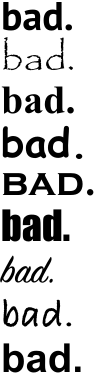
SUBMIT HEREThe theme of this year's conference is bad.
The conference will consider the role of the bad in architecture and design through the following research questions:
- How does the bad expose (often unstated) value systems?
- How does the bad reveal untapped resources of inspiration for design?
- How does the bad inspire methodologies that critique and subvert outdated perceptions about design?
- How do we negotiate with the bad in design? Or said another way, must good design negate the bad or is the bad even a problem to fix?
We will focus this discussion by considering the bad in three different categories. Click on the buttons below for more information about each one:
We want to be clear that considering the bad for this conference does NOT mean:
- Exhibiting lack of skill or intellectual rigor
- Valorizing student work receiving the lowest grades
- Cancelling people, practices, or projects
- Glorifying the bad without critique or framing
Instead, investigating the bad allows us to reorient the design disciplines’ priorities, allowing us to see which can be left behind to produce more inclusive, engaging, and relevant disciplines.
Session Types
We invite submissions for either Open Sessions (responding to the overall theme through the three categories) or Special Sessions (responding to the overall theme by focusing on specific topics or design disciplines). The Open Sessions are available to encourage a diversity of scholarly, creative, and pedagogical interests viewed through the lens of the “bad.” The Special Sessions’ calls for papers are crafted by invited moderators to create a robust discussion around a more narrowly focused and defined topic.
When you submit your abstract, you have the opportunity to select whether you would like your abstract considered for an Open Session or a Special Session. Please note that if you submit for a Special Session but your abstract is not selected, it will automatically be considered for acceptance in the Open Session category as well. Click on the buttons below for more information about the calls for papers.
Abstract Requirements (500-word limit)
Abstract submissions will be double-blind peer reviewed by at least three reviewers. Accepted abstracts will be invited to prepare their materials for inclusion in the conference, following the requirements below:
- Full Paper:
4000-5000 word paper + works cited (maximum of 5 color images)
Presentation 15 minutes at conference - Featured Project:
1000 word description + works cited (maximum of 15 color images)
Presentation 5 minutes at conference
A Full Paper should be a complete, detailed examination of ideas related to the conference theme, including methodology, results, and discussion. A Featured Project submission should focus on a specific project or assignment that explores the conference theme. Abstracts will be selected based on their relevance to the conference theme, strength of their scholarly contribution, and overall clarity. All papers presented at the conference will be included in the conference proceedings. Please note that an author may present no more than two submissions at NCBDS 42, and no individual may be listed as a co-author on more than two submissions.
How to Submit
SUBMIT HEREClick the button above to submit your abstract. Please create an account with Oxford Abstracts and answer all of the questions in the form; the text for your abstract should be copied / pasted directly into the form. Upload all images (up to 5 images for Full Paper, 15 images for Featured Project) in a single PDF.
Important Dates
- Call for Papers Published: August 28, 2026
- Abstract Submissions Due: October 24, 2026
- Abstract Acceptance Announcements: December 12, 2026
- Draft of Full Papers & Featured Projects Due: January 31, 2027
- Presentation Files Due: February 20, 2027
- Conference: February 25-27, 2027
- Final Papers for Proceedings Due: March 30, 2027
Open Sessions
NCBDS 42 will explore the concept of the bad in architecture and design and how its consideration can instigate counterintuitive methods for teaching, research, and design. You may submit an abstract for either a Full Paper or Featured Project in the Open Sessions, which will be organized into the following three categories: BAD PRACTICES, BAD DISCOURSE, & BAD PEDAGOGY. Click on the buttons below for a summary of each category. While these categories are interrelated and many submissions will engage two or more of them, you should identify the category to which your submission primarily contributes.
BAD PRACTICES
By considering BAD PRACTICES, we encourage submissions that subvert and/or question our current practices, through the lenses of both praxis and the profession. The goal is not merely to break down existing markets and “best practices,” but to explore how design pedagogy can open up new ways of working and practicing.
Traditionally, practice is a topic within design pedagogy that occurs across many different modes of inquiry, but predominantly through two main areas of disciplinary concern: through the concepts of praxis and the profession. Praxis implies, from its Greek origins, a distinction between pure theoria (thinking/contemplating) and poiesis (making/producing), and instead combines these two problematics into a third dialectical resolution that considers both thinking and making.1 Simply put, praxis refers to the productive relationship that occurs between theory and a disciplinary act of “making” or “doing.”
The profession includes the methods of making and operating within a milieu (regulatory, economic, social, cultural, and political) and the demands of clients who employ designers.2 The teaching of professional topics generally refers to the ways in which these ideas of the profession are delivered to design students, many of which are driven by the imperative to engage market forces rather than disciplinary discourse and ideas. Within the context of beginning design, how and to what degree the profession is integrated into education remains an open, contested territory. In addition, can disciplinary discourse and ideas be explored even in the presence of “unprofessional” methods?
As Reyner Banham asserted, “What distinguishes architecture is not what is done…, but how it is done.”3 This important observation, which we believe applies to other design disciplines as well, shifts significance to methods and ways of working rather than its outputs. The phrase “best practices” is used in common public discourse to codify ideal ways of being and doing. These practices are usually prescriptive: the techniques, actions, etc. that we should do to produce the best results. In contrast, we can also note proscriptive practices that we should avoid.
BAD PRACTICES is an opportunity to revisit our practices to find new ways for how our design disciplines can be done.
Potential areas of focus: ethics, practicality, efficiency, problem-solving
1 Alberto Pérez-Gómez, “Introduction to Architecture and the Crisis of Modern Science.” 2 Massimo Scolari, “The New Architecture and the Avant-Garde.” 3 Reyner Banham, “A Black Box: The Secret Profession of Architecture.”
BAD DISCOURSE
By considering BAD DISCOURSE, we encourage submissions that demonstrate ways in which discourse has been expanded within your own teaching of design and includes ways in which you have used disciplinary discourse to expand the canon.
Discourse articulates where our ideas and theories come from by asking the following questions: What sources do we read? What precedents do we look at? And which key figures do we seek to emulate? In the essay “Transdisciplinarity,” architecture theorist Mark Linder acknowledges that “Disciplines are discursive: in architecture, as in any discipline, work or knowledge appears through, and is produced by, its specific discourses.”1 However, this output is not confined to disciplinary discourse alone, as different [design] disciplines also communicate with each other through discourse. These discursive contexts, across and within disciplines, reference common ideas and theories often originating outside of those dialogues; discourse relates a discipline to broader ideas and clarifies a discipline’s specific identity in the process.
Within design disciplines, discourse often features some notion of a “canon,” widely agreed upon sources, precedents, and key figures that have made significant contributions to the discipline. This canon, however, is not fixed, and over time can vary based on changing dialogues within and across institutions, and from different schools of thought. Regardless, the notion of the canon itself implies that there are good (included) and bad (excluded) influences for design.
Rather than accepting the canon as is, we can expand it by embracing “bad influences.” This may mean referencing and utilizing existing discourse, while using productive “misreading” to expand its influence and push disciplinary discourse further (among other methods). In addition, we can open up disciplinary discourse to marginalized and suppressed figures and voices within design dialogues. In our current political climate, some may consider it “bad” to include a wider, more diverse range of designers and ideas. However, embracing this “bad discourse” makes our design disciplines richer and more responsive to an ever-changing cultural landscape.
BAD DISCOURSE offers “reconfigurations, missed opportunities, and technical innovations”2 to clarify our discipline’s identity.
Potential areas of focus: aesthetic modes, underrepresented and marginalized peoples, extra-disciplinary approaches, typology, anti-capitalism, anti-racism
1, 2 Mark Linder, “Transdisciplinarity.”
BAD PEDAGOGY
By addressing BAD PEDAGOGY, we invite submissions that discuss working with our received contexts but also creating new ones.
Every pedagogical model for instructors has some kind of context.1 This context could be the subjects and/or teaching methods that were passed down to us from the specific design and architecture schools we were educated in. It could be the professional training and experience that provided us with more credentials. It could also be the new schools of thought that we have journeyed to from other places and are now assimilated into. Or it could be ongoing dialogue with colleagues with whom we teach at our institutions.
While this context is useful and foundational, as Stanley Tigerman once provocatively pronounced, we need to metaphorically “kill” our predecessors to move beyond them and take the discipline into new territory.2 This assertion suggests critically engaging the contexts that form our pedagogical models. The zeitgeist suggests that one way of doing so is to contend with how we as academics and instructors engage with controversial subjects and precedents or with our limited (western, Eurocentric, white male) design influences. With perpetual societal and technological change, we may also consider which methods are based on outdated notions of the discipline and the profession, notions that we can unwittingly carry within our pedagogical methods and pass on to the future.
We can also expand our pedagogical ideas by embracing the idea of failure, recognizing that allowing mistakes to occur plays a vital role in effective learning. Often, encouraging beginning design students to “just do it bad” can help students who do not know how to begin, are afraid of failure, and/or are perfectionists. As we relieve the burden of avoiding mistakes, our job as educators then is to provide students with the disciplinary tools for analyzing, designing, and ultimately critiquing their work within an iterative process of design.
We can also guide students through the process of designing with “bad” typologies (such as Superfund sites, strip malls, dollar stores, etc.) and “bad” histories (by illuminating the evils of colonialism, slavery, racism, and misogyny to highlight the suppressed histories of the underrepresented). By looking at these different contexts and subjects within our pedagogy, we can communicate with students HOW design becomes a critical lens for first understanding these characteristics of the world around us more accurately, then producing new work informed by that understanding.
BAD PEDAGOGY creates opportunities to synthesize our own received contexts and adapt our teaching to embrace new realities.
Potential areas of focus: problematic history, everyday and banal contexts, outdated design methods
1 Pier Vittorio Aureli & Peter Eisenmann, “A project is a lifelong thing; if you see it, you will only see it at the end.” 2 Stanley Tigerman, “It’s Not What You Say, It’s What You Do.”
Special Sessions
NCBDS 42 will explore the concept of the bad in architecture and design and how its consideration can instigate counterintuitive methods for teaching, research, and design. You may submit an abstract for either a Full Paper or Featured Project in the Special Sessions, with each having a specific topic created by an invited moderator. These sessions will provide a discussion on a focused aspect of the conference theme. Click on the buttons below for a Call for Papers for each Special Session.
What Design Is Not: Bad Definitions, Disciplinary Boundaries, and Beginning Design Pedagogy
Tilanka Chandrasekera, PhD, Professor of Interior Design, OSU
Aditya Jayadas, PhD, Professor of Interior Design, OSU
Design education often begins by introducing students to what design is: a process of creative inquiry, problem framing, material exploration, representation, iteration, and intervention in the world. Yet beginning design students also learn what design is not. They are told that design is not decoration, artistic expression, problem solving, technical production, software proficiency, science, the artifact itself, or an isolated act of individual creativity. These negations reveal the disciplinary values, pedagogical assumptions, and epistemological boundaries through which design educators distinguish design from adjacent practices and forms of knowledge.
This session responds to the NCBDS 42 theme of “bad” by examining the productive role of negative definitions of what design is in design education. Rather than treating “bad design” only as failure, error, or poor judgment, this session uses “bad” to refer to what design is not, examining how such definitions shape students’ understanding of design as a discipline. What happens when students are introduced to design through boundaries, exclusions, and counter-definitions? When do these distinctions clarify design thinking, and when do they become reductive, exclusionary, or disciplinary gatekeeping?
The session builds on the premise that the question “What is not design?” can operate as an antithetical method for clarifying the frontiers of design. Across design scholarship, design has been distinguished from science, artistic creativity, mechanistic procedure, technical production, knowledge production, and artifact-making. At the same time, design has been framed as collaborative, contextual, social, uncertain, iterative, and situated within a continuum of pre-design, design, and post-design activities. These tensions are important for beginning design students, who are forming their understanding of disciplinary identity, creative agency, critical judgment, and professional responsibility.
We invite papers examining how “bad” definitions, negative examples, non-design tasks, and boundary cases function pedagogically. Contributions may address studio critique, design foundations, interior design, architecture, graphic design, industrial design, apparel design, digital design, engineering design, AI-assisted design, co-design, design thinking, and interdisciplinary education. Possible questions include: How do educators teach students to distinguish design from styling, decoration, engineering, art, research, computation, or production? How do students understand design when the field is blurred by artificial intelligence, digital tools, evidence-based methods, and participatory practices? Can “bad” examples help students understand design more rigorously, or do negative definitions risk narrowing what design can become?
By investigating what design is not, this session reframes “bad” as a critical device for examining how design disciplines construct their identities, teach their values, and negotiate their changing boundaries.
From Rule to Rebellion in the Typography Classroom
Nick Mendoza, MFA, Assoc Professor of Graphic Design, OSU
Pouya Jahanshahi, MFA, Assoc Professor of Graphic Design, OSU
Typography instruction in graphic design programs has historically been anchored in correctness. Beginning students are introduced to the discipline through a framework of legibility, hierarchy, and visual order, principles largely drawn from modernist European traditions that positioned clarity and neutrality as universal standards of good communication. These rules serve a real purpose: they establish a shared foundation and introduce students to the functional demands of type as a system. But these rules are not neutral; they reflect cultural values, historical traditions, and assumptions about what constitutes effective communication. When correctness becomes the primary measure of typographic value, students learn to execute inherited standards fluently but are given fewer opportunities to question the assumptions that produced them. These conventions provide a common visual language through which meaning is negotiated, making them both a constraint and a resource for design practice.
This session asks what becomes possible when typography pedagogy moves beyond correctness as its primary organizing principle and toward expression, disruption, and critical engagement. We are particularly interested in how intentional rule-breaking, the purposeful deployment of “bad” typography, can function not as a failure of craft but as an activation of it. When students understand why a rule exists, breaking it becomes an argument rather than an accident. Disruptive typographic choices carry rhetorical force. Anti-aesthetic decisions can expose the assumptions embedded in what the discipline calls good. Typography, understood in this way, is not merely a neutral vehicle for communication but a human system shaped by authority, culture, and power, one that designers can choose to reproduce or contest. This raises a broader pedagogical question: does meaningful disruption require an understanding of the conventions it seeks to challenge?
We invite design faculty and researchers to share classroom experiences, studio assignments, pedagogical frameworks, and research that have explored this territory. How have you introduced beginning or intermediate students to the critical and expressive potential of typographic rule-breaking? What assignments have asked students to move from convention toward disruption with purpose and rigor? What did students learn about typography, design history, and systems of value through working with the bad? How might typographic conventions simultaneously constrain expression and provide the very framework through which alternative voices, identities, and perspectives become visible?
We are interested in contributions that address:
- Studio assignments that structured a deliberate sequence from typographic rule to intentional, argued rule-breaking, and the student outcomes that followed
- Pedagogical approaches that introduced anti-aesthetic, vernacular, or stigmatized typefaces as tools of civic expression, cultural critique, or activist response
- Classroom frameworks that connected typographic disruption to broader questions of power, representation, and the values embedded within visual communication
- Assessments and critique structures designed to evaluate purposefully disruptive student work outside conventional standards of correctness
- Reflections on what this pedagogy revealed about the assumptions, cultural, historical, and institutional, embedded in traditional typography instruction
Before Innovation: The Potential of Inquiry in Beginning Design
James Piccone, Asst Professor of Architecture, OSU
Beginning design students often learn through playful experimentation with design techniques, materials, and concepts, not to answer urgent, large-scale questions but to get a sense of their design activities through methods of inquiry, or problem-seeking.1 As they progress through their design curriculums, though, an expectation for making problem-solving innovations through research and technology is imposed by top-down and bottom-up forces from outside the design disciplines. From above, a growing culture of assessment and evidence-based learning mandated by regulatory authorities orients students toward measurable outcomes, requiring research-driven innovation that increasingly demonstrates how, amidst global crises, students and their institutions are solving problems in practice.2 From below, narratives from industry migrate into research studios and design labs as an evolutionary model of disciplinary progress, defining innovation as the continuous combination of existing technologies into new technologies, or marketable products, that address pressing problems in the environment, economy, and society.3 When taken together, innovation as a prescriptive design culture and a techno-evolutionary process points toward a future that is less uncertain but more like a utopian version of the present4—the product of a design education in which playful experimentation and the search for new questions also remain marginalized.
Anticipating the expansion of institutional mandates and technological narratives for innovation into all areas of design curriculums is a necessary exercise for educators interested in formulating pedagogies that will continue to support beginning students’ search for questions. This special session proposes that beginning design pedagogy may be most impactful by developing students’ critical thinking abilities in a space of reflective inquiry where design experimentation leads to the construction of disciplinary knowledge, values, and meaning.5 As such, this session invites papers examining the tension between innovation and beginning design pedagogy, highlighting studio projects, design techniques, and research methods that explore the counterintuitive potential that inquiry holds for beginning design now and in the future.
1 Donald A. Schön, The Reflective Practitioner: How Professionals Think in Action. 2 National Architectural Accrediting Board (NAAB), Conditions for Accreditation; National Association of Schools of Art and Design (NASAD), NASAD Handbook 2025–2026; Council for Interior Design Accreditation (CIDA), 2024 Future Scan. 3 Matt Ridley, How Innovation Works: And Why It Flourishes in Freedom. 4 Boris Groys, On the New. 5 John Dewey, How We Think.
make believe.
Michael Frush, Asst Professor of Architecture, OSU
- [phrase] to pretend or imagine
- [noun] believing or imagining things that appear to be real, but are not real
- [adjective] representing something as real for the purpose of play
This session promotes scholarly work that explores the role of “make believe” in design education. Inspired by the conference theme “bad” and its broader categories of BAD PRACTICES, BAD DISCOURSE, and BAD PEDAGOGY, this session positions the role of make believe as pushing against the practical and the assumption of realism often found in contemporary design education, where the value of training students for a profession is often the focus. Here, make believe seeks to orient design education to a more critical and discursive lens by withholding the urge for professionalism and the assumptions of the real. In doing so we ask: What is the role of make believe as a creative practice in beginning design? How does make believe inform a productive, critical, or discursive design pedagogy? What are the techniques of make believe? What new creative logics are produced through make believe? How might make believe manifest in representational modes? How do acts of make believe compare across various design disciplines? What might we unveil about design production [or design pedagogy] through acts of make believe?
To further frame and contextualize the discussion of make believe, we can first argue that design practice is situated as a certain form of imagining the yet-to-be, of speculating on the future, and fabricating new realities which are often built on the claims of the rational and the real. The act of make believe takes this form of design practice a step further, enacting a self-conscious examination of the real through directed inquiry, exploration, substitution, and non-literality. In other words, making the irrational, the illogical, or the absurd believable. While rational design speculation operates within the limits of the real, make believe examines an acceleration of the real to new expanses that are tacitly embedded within its own logic, where more critical and imaginative futures might emerge.
With this notion of make believe as a provocational context, we welcome papers that describe pedagogical methods and design projects exploring the diverse roles that make believe plays in beginning design education – through play, experimentation, fictions, narrations, and/or imaginative world-building.
Pedagogies of Reuse
Sarah Ra, Assoc Professor of Architecture, OSU
This call seeks pedagogies of reuse in beginning design. How do we teach students to find design opportunity inside limitation, rather than defaulting to blank-slate thinking? Introducing students to designing with existing resources - rather than a clean site or program - provides constraints that can benefit the early design process. These limitations may be formal, such as awkward massing; structural, such as an existing column grid or structural bay; programmatic, such as outdated uses or functions; or material, as in designing with spolia, ruins, or reclaimed materials. Reimagining such flaws, rather than starting from a blank slate, reframes "badness" as a resource: obsolete remnants become fuel for creative work.
Because beginning students by definition typically lack disciplinary background and training, foundational design education is well-positioned to model this kind of engagement with imperfection and inherited constraint more broadly. Yet few schools currently incorporate reuse into early design curricula - an approach that could both sharpen focus in beginning design and better prepare students for the realities of practice. Recent discourse in architectural publications addresses the needs and opportunities present in adding more robust undergraduate exploration of reuse.
This session invites papers and projects exploring how imposing limits through reuse can serve as a learning tool early in design education. What are the ways that reuse can enrich the design process and the outcomes? Whether working from existing building resources or a more abstract set of inherited constraints, how can the pedagogy of reuse exploit the opportunities embedded within limitation?
Bad Abstractions
Bailey Brown Mitchell, Asst Professor of Architecture, OSU
“But it's too abstract. When do we start making real architecture?”
This session works to probe the above statement by reclaiming so-called “bad abstractions” as productive pedagogical tools in the architecture beginning design studio. Beginning design often addresses basics of form, space, order. Exercises in pattern, contrast, figure-ground, color, spatial genesis, solid and void are often perceived as pre-architecture or as “bad abstractions” that don’t yet address “real architecture.” These abstractions are often seen as being politically or socially inert – meaning that they have no tangible impact in the way that “real architecture” does.
Robin Evans argues that architecture is different than the arts in that it “inevitably provides a format for social life.”1 As such, this session argues that the abstractions common in beginning design courses enable students to design “formats for social life.” For example, the “cube projects” common in beginning design studios, though “abstract,” teach students that planes, sticks, volumes, voids, etc. structure social life by first dividing space, then rejoining it, and therefore dividing or rejoining people. No abstraction is neutral. As a result, architectural abstractions are political because they provide this “format for social life,” regardless of the degree of abstraction employed. Therefore, so-called bad abstractions are always political. Always social.
This session welcomes papers that examine projects, pedagogies, and practices that address “bad abstractions.” The session is less interested in the pedagogical necessity of abstraction to narrow a student’s focus or filter out other externalities such as materials, clients, budgets, etc. This session is more interested in examining the social and political premises of more common abstract beginning design projects.
Some questions that papers may address are included below:
- Where are abstractions present in the studio? What social or political ideologies are embedded in formal exercises?
- How do the abstractions of canonical beginning design projects (such as the figure-ground or nine-square grid) establish social or political formats? How are briefs or protocols furthering, subverting, or countering these formats?
- How do we communicate the social and political value of abstraction to students? Should we communicate this value? What’s in the lecture, the brief, the rubric, etc.?
1 Robin Evans, Translations from Drawing to Building and Other Essays.
Bad Briefs
Blake Mitchell, Asst Professor of Architecture, OSU
Design education has long relied on the project brief as a primary instrument for structuring inquiry, framing problems, and guiding student work. Yet some of the most generative learning experiences emerge not from clear and good briefs, but from those that are intentionally incomplete, contradictory, restrictive, ambiguous: qualities that may seem bad from a student perspective.
In the design studio, briefs are agents of the assignment. Briefs establish expectations, define limitations, distribute authority, and shape how students encounter the design problem. What happens when these mechanisms are disrupted? How do intentional gaps, omissions, unclear objectives, impossible requirements, shifting constraints, or conflicting goals create opportunities for critical reflection, experimentation, and most importantly, learning?
This call explores the friction embedded within the construction of design problems. A bad brief may be understood as an assignment that resists straightforward resolution, introducing uncertainty, unexpected constraints, omissions, or conflicts in ways that challenge students to negotiate the conditions of design actively. Rather than viewing flaws as deficiencies, we ask how bad briefs can function as productive pedagogical tools.
We invite contributions that examine the role of bad tasks, prompts, programs, assignments, and briefs from all design disciplines.